Springe zum Hauptinhalt

From Founding Tallence to Exploring the Future of Creativity

Nicole Schroeder interviews Mike Brauner

Highlights // Tallence Editorial Team // 19.08.2026
Blog Post Interview Mike Brauner 1200x1200px

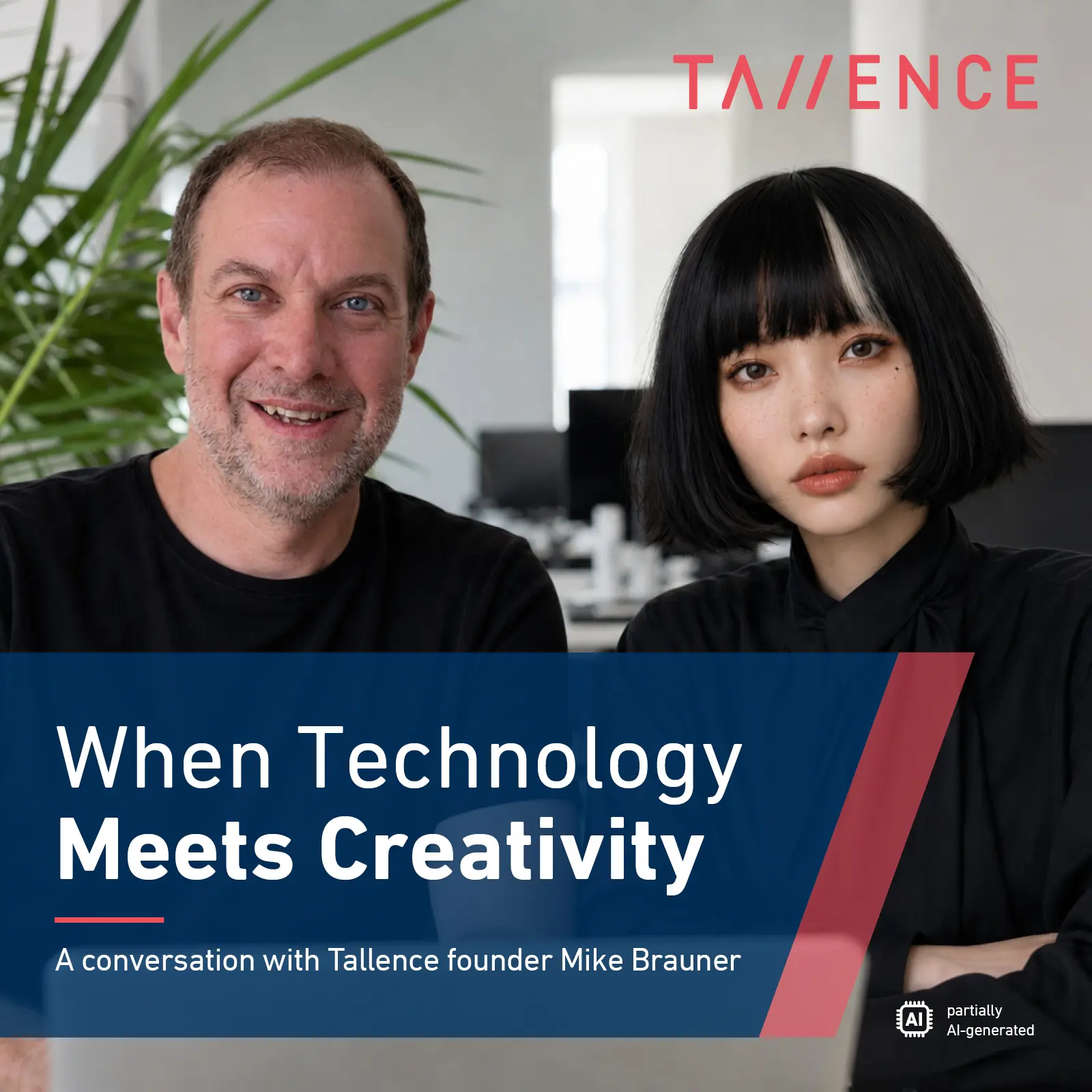
Mike Brauner, co-founder of Tallence and The AI Art Magazine, together with Blyss, AI Marketing at The AI Art Magazine.

When Tallence was founded in 1999, digital transformation was still a vague idea for many businesses. Today, more than 25 years later, Tallence stands for meaningful digital transformation across industries - from telecom to digital platforms and customer-facing experiences. Publicly available company information describes Tallence as having grown from a handful of students into a company with more than 130 people across six locations.

One of the people behind that entrepreneurial beginning is Mike Brauner - co-founder of Tallence and, to this day, an active force in the business, especially around the kind of Digital Experience questions that continue to shape customer relationships, products, and platforms. Beyond Tallence, Mike also co-founded The AI Art Magazine, a project that has gained international media attention, including coverage in Forbes, Euronews, The Art Newspaper, and ARTnews. (The AI Art Magazine)

For this interview, I spoke with Mike about the early days of Tallence, what has changed in digital business over 25 years, and why the intersection of technology and creativity matters more than ever.

Hinweis: Dieses Interview ist nur in englischer Sprache verfügbar.

Nicole Schroeder: Mike, let’s start at the beginning. When Tallence was founded in 1999, what was the original idea?

Mike Brauner: The original idea was actually very simple: build meaningful digital solutions with substance. Back then, the market looked very different. “Digital transformation” was not yet the management phrase it is today, but the need was already there. Companies were beginning to understand that digital systems, interfaces and processes would become business-critical.

What drove us from day one was curiosity, entrepreneurial energy, and the ambition to create things that are useful, sustainable and relevant for clients. That mindset has stayed the same, even as the technologies, industries and scale have changed dramatically.

Nicole Schroeder: Tallence has grown a lot since then. What do you see as the biggest shift from the early years to today?

Mike Brauner: The biggest shift is that digital is no longer a supporting function. It is the business. Twenty-five years ago, many digital initiatives were treated as side projects. Today, customer experience, platforms, data, interfaces and intelligent automation sit right at the center of business strategy.

The second big shift is complexity. Businesses are dealing with legacy landscapes, fragmented customer journeys, rising user expectations, and now, of course, AI. That means the real challenge is no longer just building technology. It is designing systems and experiences that people can actually use, trust and scale.

That is exactly why topics like Digital Experience have become so important. Great technology without a meaningful human experience rarely creates lasting value.

Nicole Schroeder: That’s interesting, because people often separate technology from creativity. You clearly don’t.

Mike Brauner: I never believed that separation made much sense. The best digital products have always been a combination of logic and imagination. Technology gives you capability; creativity gives you relevance.

If you look at customer platforms, service journeys, digital products or communication interfaces, they all succeed or fail at the point where systems meet people. That is not just an engineering problem. It is also a design problem, a language problem, and often a cultural problem.

That is why I have always been interested in the overlap between business, technology and creative thinking. It is where innovation becomes tangible.

Nicole Schroeder: Is that also what led you to co-found The AI Art Magazine?

Mike Brauner: Yes, very much, though from a different angle than people might expect. The magazine didn't start with the technology. It started with the artists who were already working with it, often before anyone had language for what they were doing.

AI is changing more than productivity or automation. It's changing how we think about authorship, creativity, aesthetics and interaction. That's what makes it culturally significant, not the technical novelty on its own.

The AI Art Magazine exists to take that work seriously: not the hype around AI, but what a specific artist actually made, and what that reveals about the relationship between intent and machine capability. We'd rather go deep on one artist's process than survey the trend. 

Nicole Schroeder: Public coverage suggests the magazine quickly gained international visibility. What has that response meant to you?

Mike Brauner: It has been very encouraging. When a project like this receives attention across international media, it tells you that the conversation is bigger than a niche trend. Public reporting has described the magazine as a German-founded biannual publication exploring the fusion of human and machine creativity, and that is exactly the discussion we wanted to help elevate. (euronews)

What matters most to me is not visibility for its own sake. It is the signal behind it: people are actively looking for serious, thoughtful formats that help them understand what AI means in culture and in practice.

That same need exists in business. Leaders are not just asking, “What can AI do?” They are asking, “What does it mean for how we create value, communicate, design services, and build trust?”

Nicole Schroeder: Forbes covered The AI Art Magazine in late 2024, and the magazine’s own press page shows another Forbes mention in 2025. What do you think explains that resonance?

Mike Brauner: I think the project resonates because it sits at the intersection of several important conversations at once: AI, creativity, design, authorship, and the future of human work. Those are not isolated topics anymore.

Also, the magazine is deliberately physical. In a moment when AI evolves at incredible speed, putting something into print creates friction on purpose. It says: slow down enough to actually look at what an artist made, not just scroll past it. That tension between speed and attention is powerful. And I think that is part of why the project attracted attention. 

(The AI Art Magazine)

Nicole Schroeder: Bringing this back to Tallence - what does a project like this say about the company’s DNA?

Mike Brauner: To me, it says that Tallence has never been about implementing technology for its own sake. We have always looked at how technology changes markets, organizations and human behavior.

That mindset is still essential today. Whether we are talking about Digital Experience, digital platforms, telco transformation, or new AI-enabled services, the real question is always the same: how do you turn technical possibility into something meaningful for people and for business?

Tallence was founded in a moment of digital change. It continues to grow in another moment of profound change. The tools evolve - the principle does not.

Nicole Schroeder: If you had to describe Tallence’s journey from 1999 to today in one sentence, what would it be?

Mike Brauner: Tallence has always tried to stand at the point where change becomes opportunity - and then help clients move forward with clarity.

Nicole Schroeder: Final question. What excites you most right now?

Mike Brauner: The fact that we are once again in a moment where the rules are being rewritten. Those phases are demanding, but they are also incredibly energizing.

AI, new interfaces, new forms of digital interaction, new expectations around customer experience - all of that is creating pressure, but also possibility. The winners will not be the companies that chase every trend. They will be the ones that combine technological depth with human understanding.

That is where I believe Tallence can continue to make a real difference.

About Tallence

Tallence began in 1999 with curiosity, ambition and a belief in meaningful digital work. More than 25 years later, that founding spirit still matters. In Mike Brauner’s journey - from co-founding Tallence to helping shape conversations around AI, creativity and human-machine collaboration - there is a thread that feels especially relevant today: transformation is never only about technology. It is about what people do with it. 

And that may be the most important story of all.

// Kontakt

Nicole Schröder

  • Head of Marketing